Strength training for Osgood Schlatter Disease

Jacob Tober
8 min read
Strength exercises, performed correctly and with the right amount and at the right times, are an essential part of treating Osgood Schlatter Disease.
With progress at strength exercises athletes get back to playing sport pain-free - feeling stronger, faster, and more resilient than ever before.
Strength exercises are critical for treating Osgood Schlatter
When we experience pain and injury, the muscles surrounding the injured site become reflexively inhibited as a protective mechanism. The body’s intention is to shut down the muscles to protect and promote recovery.
With knee pain like Osgood Schlatter Disease, the muscle group affected most are the the quadraceps - a big, powerful muscle group on the front of the thigh. The quads are crucial in running and jumping, and they support and de-load the knee tendons.
As Osgood knee pain persists, the quads remain inhibited and gradually become weak and even atrophy (shrink in size). As a result, the tendons and joints take more of the forces from sport and daily life, increasing the Osgood pain further.
With well chosen exercises and a gradual progression plan we can undo this counter-productive quad muscle inhibition. Once they are no longer inhibited, they get back to absorbing force, protecting the knee joint and ultimately reducing Osgood pain.
The best strength exercises for Osgood Schlatter Disease
Knee isometric holds
Isometric holds (or ‘Isos’) are incredibly effective at settling down sore knees and strengthening the muscles required to protect and support the knee. We’ve seen athletes drop from a 7/10 on the pain scale, to 0/10 in 5 minutes with isometrics
Isometrics are a particularly great starting exercise for children or adults suffering from Osgood Schlatter Disease because they load the quad muscles without moving the knee through uncomfortable ranges of movement. Despite many common gym myths, we do not need full ranges of motion to build strength in a muscle group.
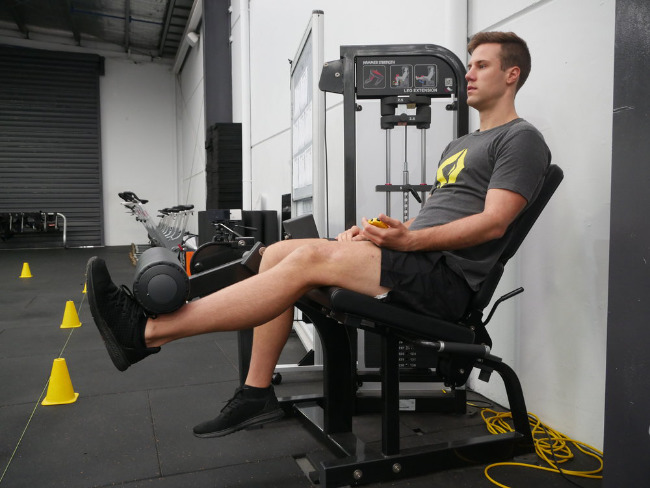
Isometric holds are also effective because they take advantage of a phenomenon called mechano-transduction. Mechano-transduction takes advantage of isometric loads to change the physical properties of the tendon helping it heal and become stronger.
We use knee isos as an early intervention on the path to stop the cycle of quad inhibition and reduce knee pain.
Shallow squats
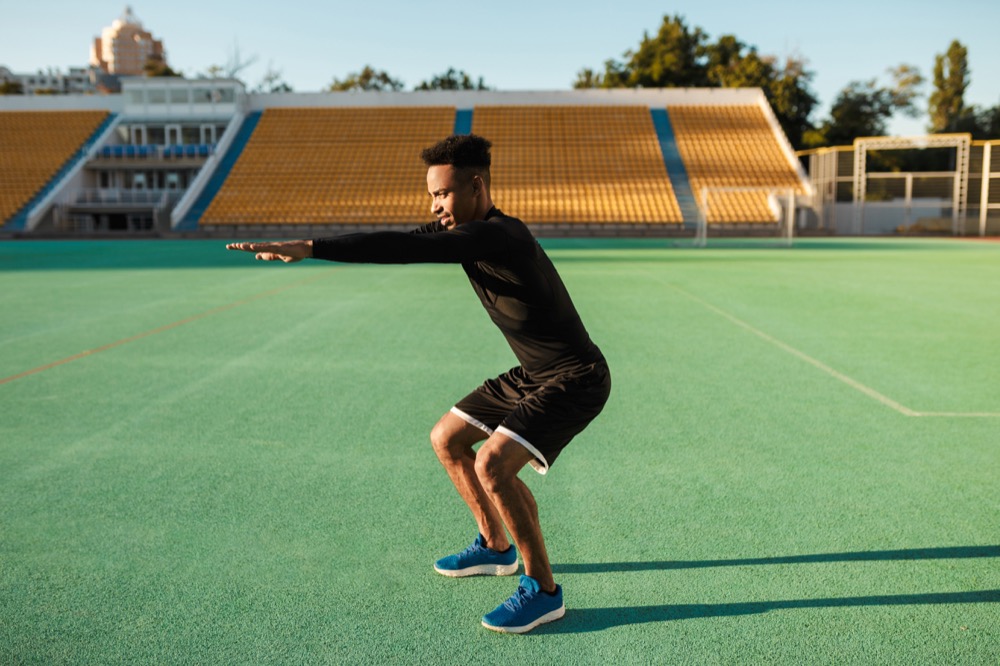
Squatting, when performed correctly, is one of the most important strength movements for helping you beat Osgood Schlatters.
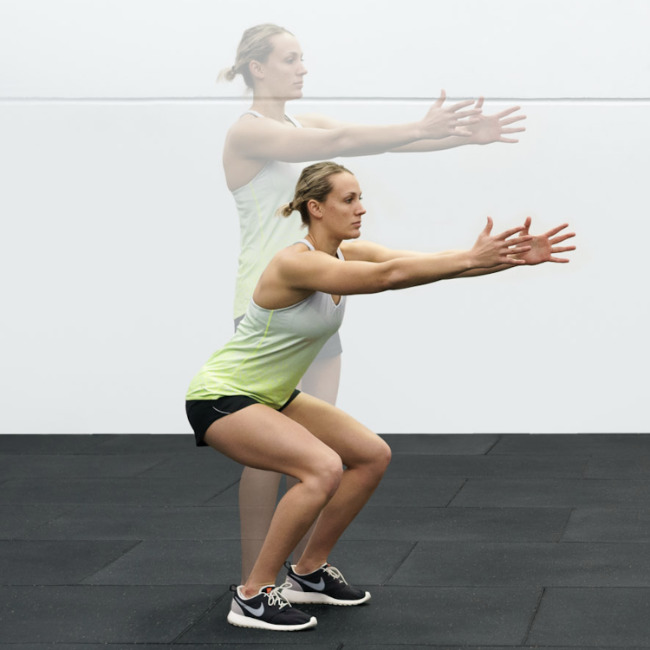
Shallow squats have many benefits but the key one is that they are a re-patterning exercise. Re-patterning with shallow squats help athletes switch from a knee dominant movement pattern (which overloads the sore knee tendon) to a glute dominant pattern, which is better for knees and a more athletic way to get low. This translates to huge improvements in the jumping and landing technique.
A common problem we see with squatting is that almost everyone performs them incorrectly. They are often done too deep, too wide, too knee dominant, are caving in at the knees, or with bent and twisted spines. It can be a total mess. Starting shallow and focusing on great technique with a smooth pattern is an essential part of our approach to treating Osgood Schlatters.
Calf raises
Strong calves are increadibly under-rated for most young athletes, but they are hugely influential in reducing the forces that knees have to absorb.
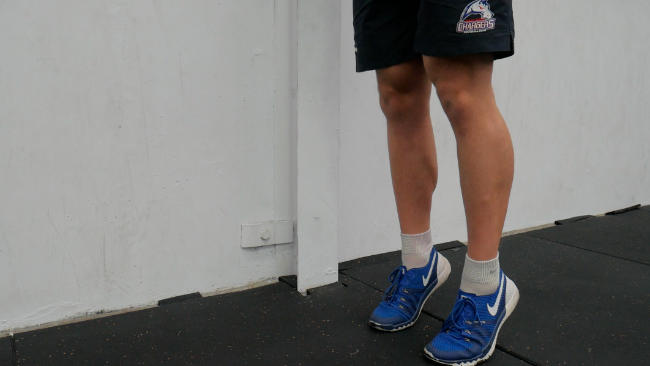
For young athletes with Osgood Schlatters, bodyweight calf raises under slow control without bouncing are absolutely critical.
Frequently in a commercial gym teenage athletes will gravitate towards the calf-raise machine where they can load up calf raises with weight, but when tested they cannot actually complete proper bodyweight calf raises with good movement control!
Now is the perfect time to start strength training
Sensible strength training is absolutely needed for athletes with Osgood Schlatter Disease - even if they are currently experiencing knee pain!
(Many parents of young athletes have heard that strength training stunts growth - this is a shockingly unhelpful myth not supported by any scientific evidence. Read more here.)
In our program athletes rapidly reduce pain thanks to the impact of strength training in the right doses. Any treatment for Osgood Schlatters inevitably involves sitting out some amount of sport training, and the best thing to do with that time is performing regular strength development for muscles and tendons.