The secret to curing Osgood Schlatter Disease

Durham McInnis
8 min read
UPDATE 2022:
I originally published this case study on our gym’s website in 2014 and was overwhelmed by requests from parents all over the world looking for help getting their teenager back to sport. It was shocking to learn how most people were being advised that the cure for Osgood Schlatters is to stop playing sport for months or years (it isn’t!)
We subsequently launched this website and created what we believe is the most effective at-home treatment program for Osgood Schlatter Disease. I am thrilled that we are able to deliver this phenomenal treatment to so many people outside our hometown!
Today I’m going to reveal how we cure Osgood Schlatter Disease in a matter of weeks.
In our sports performance gym we have been fixing this serious and painful problem for years. Our approach defies conventional wisdom, consistently helping young athletes return to sport pain-free while still in the middle of a growth spurt. It is one of the most meaningful and rewarding rehabilitations we do.
This is a really big deal, but until recently we didn’t realise HOW big a deal. More and more promising young athlete’s dreams are being shattered because the standard treatment and advice just aren’t working.
Osgood Schlatter Treatment Case Study: Sarah
The catalyst for writing this article is our basketball athlete Sarah and her incredibly sore knees.
Sarah was referred to me eight weeks ago, having carried serious Osgood Schlatters pain for months.
Sarah is a 12 year old kid of normal height hobbled by severe pain in her knees. Despite having excellent genetics and a strong athletic frame she did not move well. In fact when I saw her on court, I thought she looked more like an over-60s player than an under-14s!
Two weeks after starting with us she was almost completely pain-free!
We just hit week eight and she is scoring a 0 out of 10 for pain, and back to moving around the basketball court like the true athlete she is.
Examining Sarah’s original treatment plan
Throughout her prolonged injury, Sarah had been under the caring and focused treatment of a diligent and excellent health practitioner. They were kind enough to send me a 2-page letter detailing all the adjustments, mobilisations, activations and rehab activities prescribed to Sarah in an effort to alleviate her pain, all to no avail.
After achieving an significant reduction in pain levels in just weeks of coaching, I went back to really examine her practitioner’s referral letter. I was struck by the fact that despite being a textbook application of the traditional modalities for treating Osgood Schlatter Disease, the treatment list didn’t include any of our top treatments. Not one!
To me, her previous program was all frosting and no cake.
There was a lot of time and effort spent fiddling around in the margins to try to help with her pain, but nothing striking at the true heart of the problem.
Why is that?
The normal medical understanding of Osgood Schlatter is that it cannot be cured until the growth phase stops. As a result, even the most helpful doctors and therapists resort to pain management, or recommend stopping sport altogether.
Luckily our hometown (Melbourne Australia) is a hub of sports-science research, and over several years we have developed a genuine treatment for Osgood Schlatter with some of the brightest minds in the field.
Understanding Osgood Schlatter Disease
To understand our approach to Sarah’s case, it helps to understand the real cause of Osgood Schlatter Disease.
Put simply, Osgood Schlatter Disease occurs when the thigh bone (femur) grows too fast for the longest quad muscle (rectus femoris) to keep up. This means with every step the athlete takes the muscle is pulling aggressively at its attachment site below the knee cap (the tibial tuberosity).
Below is an isolated picture of the femur and rectus femoris, and a closer view of the knee. The shiny thing in the middle is the prepatellar bursa which sits in front of the kneecap itself (the patellar). You can see the tendon runs from the quad and down to its attachment site at the top of the shin bone (tibia).
A tight quad that can’t keep up with a rapidly growing femur is going to cause drama at the tibial tuberosity.
It’s as though the bones are literally tearing the tendon off its attachment site at the top of the shin.
The issues are compounded by the fact that the attachment site at the tibial tuberosity are not fully bonded in teenagers. During the teenage growth spurt it stays like semi-set glue to allow for further growth.
For taller kids who have super weak glute muscles, terrible running styles, (and for many a 48-week season on hard court surfaces) it’s not surprising we see plenty of Osgood cases, particularly in soccer, basketball, tennis, and voleyball.
Sarah’s new treatment plan
Now we are clear that Osgood Schlatter Disease is basically bones growing too fast for tight muscles resulting in still-developing attachment points getting angry.
How did we apply this understand to Sarah’s case?
If we could wave a magic wand we might be successful by just temporarily stopping her growth spurt — and this is kind of like the traditional advice to just stop being active and wait it out. Not a good option.
But if we start treating Osgood Schlatter Disease like a tendon problem instead of a bone problem, we suddenly unlock the ability to cured her pain in just a few weeks!
Step one: Create length in the quad
The first and most important step is to create some length in the quad to accommodate the rapid bone growth and take a little pressure off the attachment site. That’s the obvious part.
Unfortunately by stretching the quad you are actually pulling on the sore attachment site increasing inflammation. Not cool. This vicious cycle is what trips up most people.
Instead we leverage foam rolling for self-myofascial release. The beauty of foam rolling for Osgood is that it allows us to lengthen the quad and help it catch up to the femur without pulling at the sore bit.
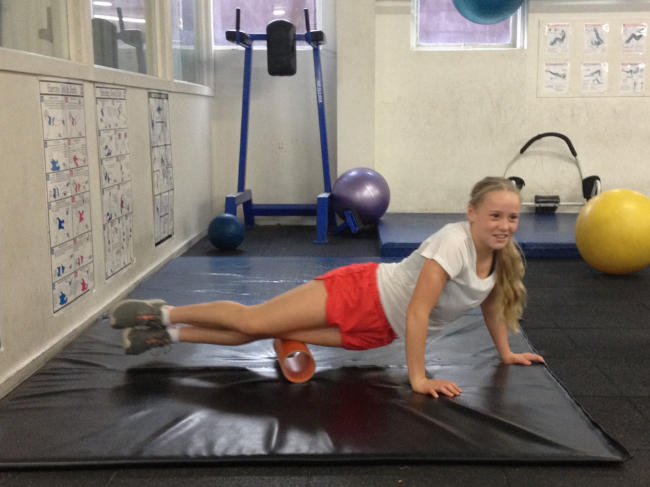
Sarah is using a hard PVC plumbing pipe for rolling - definitely an advanced option not recommended for most!
Once the rolling starts working and Sarah’s knee became less angry, we then introduced gentle stretching.
The stretch below is my favourite, as it locks down the rectus femoris from both ends giving it nowhere to hide. It is a pretty strong stretch we implement in latter stages of treatment - there is technique involved to ensure it has the desired effect and will not make the knee worse!
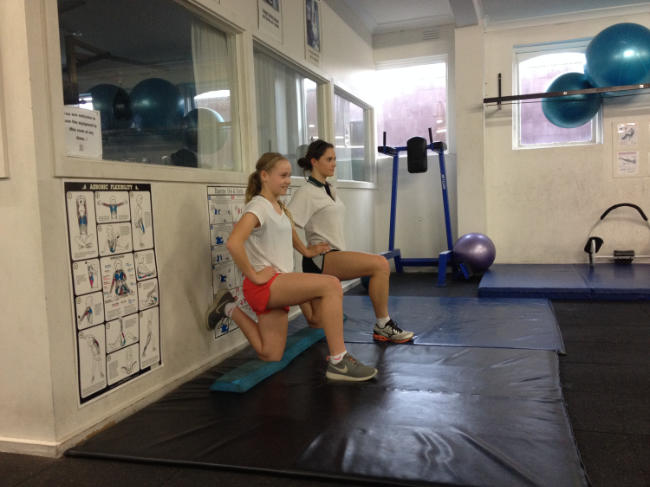
As you can see from the picture, Sarah’s quad flexibility is still a work in progress. But you only need to create the smallest fraction of additional length to dramatically reduce the traction on the tuberosity and get the knee out of the angry phase.
Step two: Create strength in the quad
I like to think of athletic qualities like vitamins. Some we have too much of, some we have too little.
In these terms, strength deficiency rank a very close second to flexibility deficiency in teenage athletes. Often deficiencies like these remain hidden as it is sometimes hard to see weakness in strong-looking sporty teenagers.
Much of this weakness can stem from muscles becoming reflexively inhibited in the presence of pain. These kinds of reflexes are handy at preventing us from lifting loads so heavy we snap our tendons off. But for athletes with knee injuries they are problematic, as the muscle that should be soaking up the kinetic energy of movements are leaving the tendons and attachment sites to take the brunt of the force.
In Sarah’s case then, this reflexive inhibition of the quad is a bad reflex. The great news is we can activate these muscles almost instantly and start to get the quads to do their job from day one by using isometric holds.

Sarah was so weak that when she started she couldn’t even hold the lightest weight for 5 seconds. I’ve trained elderly people who were considerably stronger!
Isometric holds (or ‘Isos’) are incredibly effective for tendons and tendon-related problems. I have seen them take someone from 7/10 soreness to 0/10 in less than 5 minutes. Near end-range holds are so beneficial that we just start and finish with the leg in the almost fully extended position as pictured above.
Conclusion
Sarah’s case illustrates our fundamental approach to curing Osgood Schlatter Disease and how it re-thinks treatment.
Our full treatment plan extends on these initial steps to make sure Sarah is set up for success and avoids a recurrence of her Osgood. This is something we have achieved with dozen’s of athletes in our gym.
Update in 2023: now hundreds in our gym, and several thousand through our online treatment program!
Athletes who commit to the process not only recover from Osgood Schlatter, but also become more athletic, accelerating their sports performance. Hugely important to me is that we keep them playing sport instead of sidelining them for the length of their growth spurt — a psychological disaster for too many young athletes with Osgood.
If you are located in Melbourne Australia please do reach out for an in-person assessment or to apply for our Athletic Development Program. You can find information about our High Performance Centre and physiotherapy clinic on our website.